
LOMA vs. LOMR: How to Remove Your Property from a High-Risk Flood Zone
Learn the difference between LOMA and LOMR. Discover how a FEMA map amendment can remove your property from a high-risk flood zone and lower insurance costs.
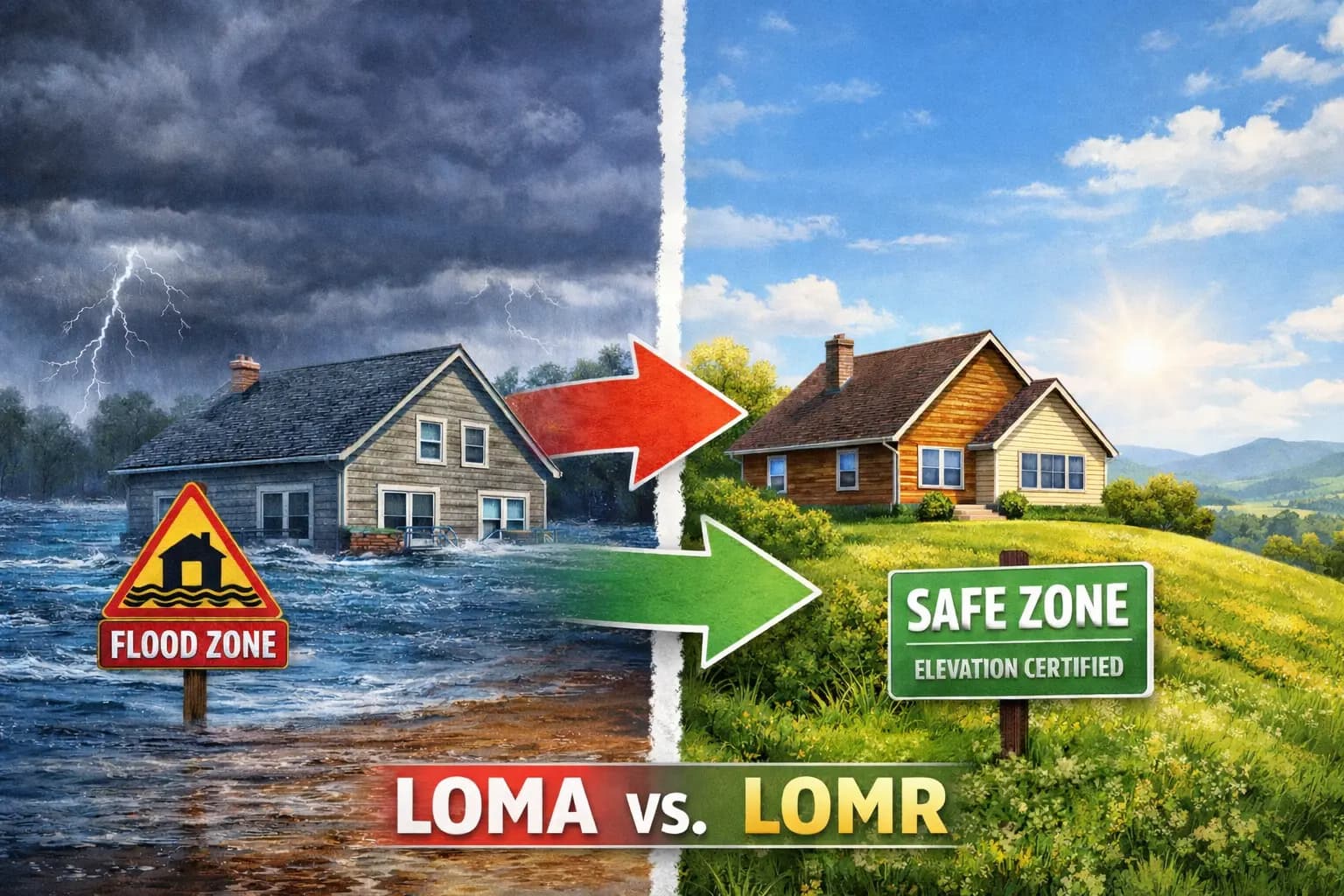
Flood zone classifications might sound like something only surveyors or government agencies care about, but for property owners, they can have a significant impact on their wallets. If FEMA’s flood maps indicate your property is in a high-risk flood zone, your lender will almost always require you to carry flood insurance. That can easily translate into a few thousand dollars every single year. Even worse, your property could carry the stigma of being “flood-prone,” which can affect its value.
FEMA (the Federal Emergency Management Agency) issues and revises these flood maps, but the maps are general by nature. They utilize community-level data and computer simulations and models, which may not capture the nuances of a specific property. Therefore, your property, although located in a high-risk flood zone, may be on higher ground than the other properties in the area. You could be paying for costly flood insurance even though your actual flood risk is less than indicated on the flood map.
This is where tools such as a Letter of Map Amendment (LOMA) or a Letter of Map Revision (LOMR) are utilized. A LOMA is generally applied to one individual property to remove it from the high-risk flood zone. Conversely, a LOMR is a more extensive adjustment that can involve multiple properties or even an entire community.
For property owners, a LOMA or LOMR can be a game-changer. Not only can it ease the stress of being in a high-risk zone, but it may also lower your insurance costs (or even remove the mandatory flood insurance requirement altogether). And the best part? These processes are well established. FEMA has clear steps you can follow, so if you suspect your property has been wrongly classified, you’re not stuck. Let’s get into understanding LOMA and LOMR in detail.
What is a LOMA (Letter of Map Amendment)?
A Letter of Map Amendment, or LOMA for short, is simply FEMA's method of saying, "Okay, although the map indicates the area is a high-risk zone, your property is technically outside of that zone based on how it was constructed." It's a formal letter stating that your property was incorrectly mapped into a Special Flood Hazard Area (SFHA), despite being constructed above the flood level determined on the flood map.
Here’s how it usually happens: FEMA maps are made using broad surveys and community-wide data. They’re not going property by property and taking measurements. So if your property is on a slightly elevated patch of land or your foundation is higher than others in the area, the map may not address that level of detail. The result? Your property gets designated as being in a high-risk zone even though it’s not, and your lender is mandating that you carry flood insurance.
That’s where a LOMA steps in. It’s the tool property owners use to say, “Wait a minute, my property doesn’t belong in this flood zone.” And FEMA provides a way to prove it. Typically, you’ll need an elevation certificate (a document that shows where your property sits relative to the Base Flood Elevation [BFE] and adjacent grade) and a property survey. Additional documentation might also be needed from an engineer, surveyor or community official so that FEMA has all the details needed to respond to the LOMA request.
The good news? If everything checks out, FEMA will update its records and issue you a LOMA. And here’s the payoff: with that LOMA in hand, you can go back to your lender and show them that your property isn’t actually in the high-risk zone. In many cases, that can mean you’re no longer required to carry flood insurance. It’s not a flashy process, but for a property owner who feels wrongly classified, a LOMA can be a real money-saver over the long run. It is important to note that even if a LOMA is provided it doesn’t mean that the property has no flood risk and maintaining flood insurance is still a wise decision.
What is an LOMR (Letter of Map Revision)?
Now, where a LOMA is correcting the flood risk classification for one particular property, a LOMR, or Letter of Map Revision, is more of adjusting the flood risk classification for multiple properties, areas or an entire community on FEMA's flood map. Rather than dealing with individual properties, a LOMR spans larger areas and impacts many properties.
But unlike a LOMA, which is mostly paperwork and a survey for one property, a LOMR is a much bigger lift. It requires hydrologic and hydraulic studies (fancy terms for water flow and flood models) prepared by licensed engineers. They conduct simulations that demonstrate how water flows through the region, showing that the flood hazard has changed.
Consequently, requesting a LOMR is not something that most property owners do on their own. It's commonly led by developers, homeowner associations, or local governments, as it affects multiple properties simultaneously. It’s also more costly than a LOMA and takes longer.
So, while a LOMA is quick and personal, a LOMR is broader and more technical. But the result can be powerful. If FEMA approves a LOMR, the updated map can lower flood risk designations for an entire area or the whole community. That means property owners might no longer be required to carry flood insurance, or at least may see their premiums go down.
LOMA vs. LOMR: Key differences
At the end of the day, both a LOMA and a LOMR are about making sure FEMA’s flood maps are accurate and current. But the scale of correction is where they really part ways.
A LOMA is very property-specific, usually brought forward by a single property owner who realises their property elevation is higher than what the map shows. It’s simpler, quicker, and generally more affordable because it typically just involves a survey, an elevation certificate, and FEMA’s review.
A LOMR, on the other hand, is more of a community-level adjustment. It’s less about one property and more about a whole area. For example, if a city has installed a new drainage system or made changes that alter how water flows, the local government or developers might step in and request a LOMR to update the maps. It’s more technical, more expensive, and definitely takes longer.
Another big difference is who initiates the process. A LOMA is usually in the hands of the property owner. You’re the one gathering documents, hiring a surveyor, and filing the request. A LOMR, though, is almost always handled by local authorities, homeowner associations, or engineering teams, since the changes affect multiple properties and require in-depth studies.
And of course, there’s the insurance impact. With a LOMA, the benefit is personal: if FEMA agrees your property isn’t actually at high risk, you may no longer be required by your lender to carry flood insurance. That can translate into significant annual savings. A LOMR, on the flip side, can shift the needle for entire communities. If FEMA revises the flood zone designation for your neighborhood, premiums may go down for several property owners at once.
FEMA Map Amendments: Why they matter
When FEMA says your property is in a Special Flood Hazard Area (SFHA), that label comes with some baggage: higher insurance premiums, stricter lending conditions, and sometimes, a harder time selling the property down the road.
That’s where a FEMA map amendment comes in. Whether it’s through a LOMA (for a single property) or a LOMR (for a bigger area), getting that map corrected can make a world of difference. It’s not just about the savings, though. Properties outside of high-risk zones tend to be more attractive to buyers. Think about it: if someone is deciding between two homes, one that requires mandatory flood insurance and one that doesn’t, the choice is pretty clear. Lower ongoing costs make your property more marketable.
How to apply for a LOMA or LOMR
The application process follows a series of steps:
- Start by reviewing FEMA's Flood Map Service Center to find out your property's present "flood zone classification." (FEMA Flood Map Service Center | Search By Address).
- Employ a licensed surveyor or engineer to perform an elevation survey and provide an elevation certificate.
- File your application on FEMA's forms. Use the MT-EZ form for LOMAs, and the MT-2 form for LOMRs.
- Wait for FEMA’s review. A LOMA can take weeks, while a LOMR may take several months.
- Once FEMA issues its determination, share the updated classification with your lender and insurance company.
Common Mistakes to Avoid
Navigating the LOMA or LOMR process isn’t overly complicated, but there are a few common slip-ups that can trip people up. One of the biggest mistakes is sending in incomplete or inaccurate paperwork. For example, if your elevation certificate is missing details or your property survey has errors, FEMA may simply reject it.
Another common pitfall is misunderstanding the Base Flood Elevation (BFE). Some homeowners assume that because their property looks higher than their neighbor’s, they’ll automatically qualify for a map amendment.
And then there’s the step that many forget entirely: updating lenders or insurance providers once FEMA approves the amendment. Without that, your lender may still treat you as though you’re in a high-risk flood zone, and you’ll keep paying those premiums.
Expert Tips for Property Owners
If you’re thinking about applying for a LOMA or LOMR, a little preparation goes a long way. Here are a few tips that can make the process smoother:
- Always get an elevation certificate upfront.This document is the backbone of your application and shows precisely how your property sits relative to the BFE and adjacent grades.
- Work with licensed professionals. Hiring a surveyor or engineer might feel like an extra cost, but their accuracy can save you both time and money in the long run.
- Keep an eye on FEMA’s flood maps. These maps get updated, sometimes after local development or new flood studies. Just because you’re safe today doesn’t mean the map won’t change tomorrow.
- Talk to your insurance agent once FEMA decides. If your zone changes, you’ll want to make sure those potential savings on your premium actually show up in your policy.
FAQs
1). What is the difference between a LOMA and a LOMR?
2). How long does it take to have a LOMA or LOMR approved?
3). Will obtaining a LOMA or LOMR lower my flood insurance rates?
4). Where do I begin if I believe my property is in error?
Conclusion
If you believe your property has been incorrectly classified as a high-risk flood zone, both LOMA and LOMR are valuable resources. They can help property owners secure the best possible insurance premiums and enhance their property's appeal to buyers in the real estate market. Over time, a change in flood zone classification can have a significant effect on your finances.
If you're unsure where to start with flood insurance for your home, our team of experts at Advantage Flood can help you explore your options and make informed decisions with confidence.