
Community Rating System and Flood Insurance Discounts: How CRS Affects Your Premium
Learn how the community rating system can lower your costs. Explore flood insurance discounts and how CRS affects your premium for better savings.
Flooding is one of the most devastating natural disasters in the United States, costing billions of dollars each year. Storms and floods become more frequent and intense as climate change progresses. While flood insurance is critical for protecting homes and businesses, rising costs may discourage people from purchasing it. Thankfully, FEMA’s Community Rating System (CRS) offers a way forward by rewarding entire communities with lowered flood insurance premiums through their active efforts to increase flood risk knowledge and reduce flood risk. This blog explains how CRS works, the kinds of flood insurance discounts available, and how you can maximize savings, both personally and as a community member, while building resilience against floods.
Introduction
Flood damage is not only emotionally upsetting, but also financially devastating. However, many homeowners and renters believe flood insurance is too expensive. FEMA's Community Rating System (CRS) demonstrates that affordability is possible if municipalities and individuals take proactive measures. Communities can earn CRS points by providing flood education, upgrading infrastructure, and implementing stronger building requirements, resulting in significant flood insurance savings for residents.
What Is the Community Rating System (CRS)?
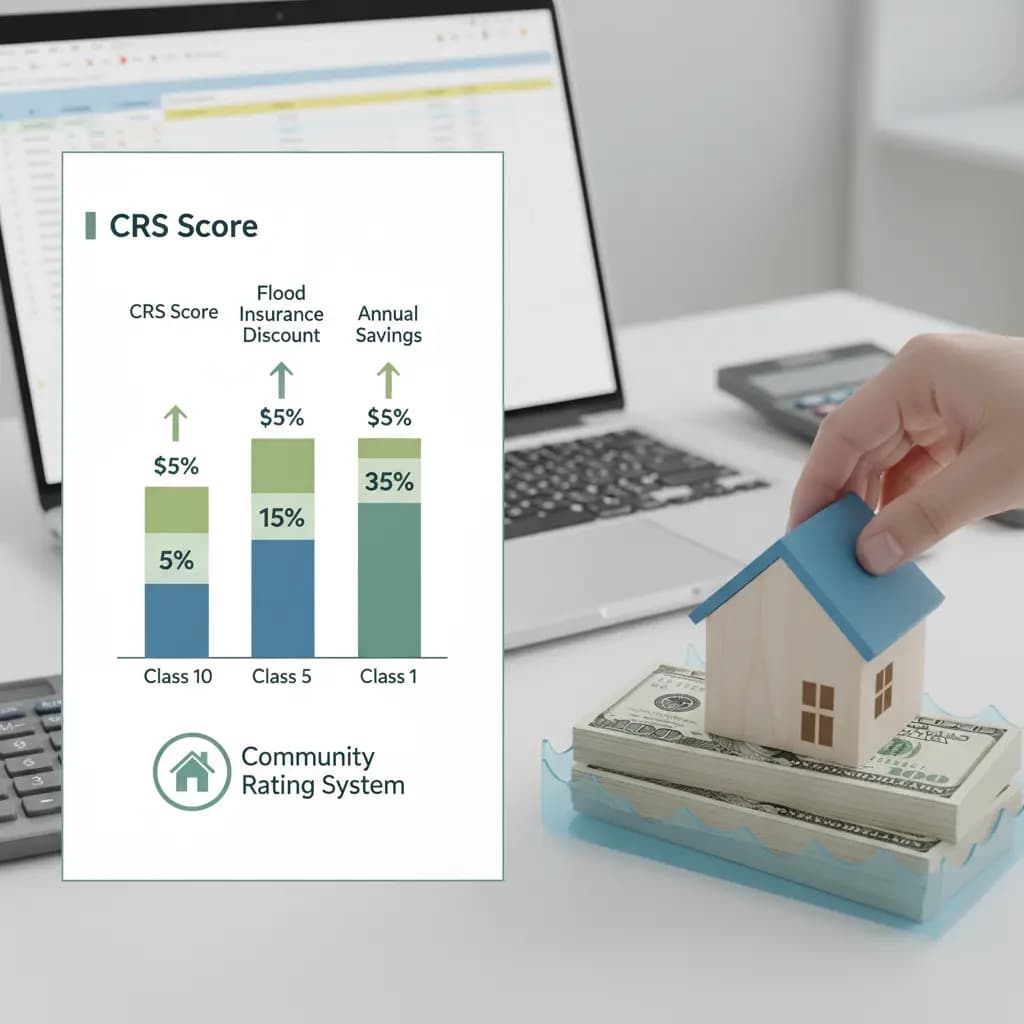
FEMA created the Community Rating System (CRS) to encourage local governments to invest in flood risk mitigation efforts beyond minimum NFIP requirements. Communities earn points and are ranked into CRS classes from 10 (no participation) to 1 (most proactive) by completing activities such as flood awareness campaigns, updating flood maps, maintaining drainage systems, and adopting stronger building codes. The result? Every policyholder in that community receives flood insurance discounts based on the CRS class. For many residential and business properties, this means significant savings each year and better protection against future flood events.
How the CRS Impacts Flood Insurance Premiums
Here’s how the CRS directly affects your flood insurance premiums:
| CRS Class | CRS Points Required | NFIP Premium Discount |
|---|---|---|
| 1 | 4500+ | 49% |
| 2 | 4,000–4,499 | 40% |
| 3 | 3,500–3,999 | 35% |
| 4 | 3,000–3,499 | 30% |
| 5 | 2,500–2,999 | 25% |
| 6 | 2,000–2,499 | 20% |
| 7 | 1,500–1,999 | 15% |
| 8 | 1,000–1,499 | 10% |
| 9 | 500–999 | 5% |
| 10 | 0–499 | 0% |
For homeowners, flood insurance premiums can be daunting, especially in high-risk zones. But the community rating system translates community efforts into financial relief. Communities rated between Class 9 and Class 1 earn incremental flood insurance discounts, with Class 9 yielding a 5% reduction, Class 8 at 10%, and so on, up to Class 1, which offers a compelling 45% discount.
This structure means your premiums are reduced in recognition of safer, more resilient environments. It’s essential to recognize that these flood insurance discounts apply regardless of where your property sits in the floodplain: you save whether in a moderate- or high-risk zone. For cities already investing in flood risk reduction, CRS provides a direct, tangible return, lowering both individual expense and overall risk exposure.
What Communities Do to Earn Discounts
Communities that want to get a higher CRS class use a lot of different flood-smart policies and practices. They often start by spreading the word by giving out brochures, holding seminars, and keeping websites up to date with information about flood zones and safety measures. As they grow, communities may change their zoning laws to give them more control over how land is used and adopt stricter building codes that require buildings to be higher up or resistant to flooding. Improvements to infrastructure, like better stormwater systems, dredging rivers, or raising roads, further demonstrate that the goal is to reduce flood damage. Communities may also purchase repeatedly flooded property to turn it into green space that the entire community can enjoy. Finally, these efforts end with promoting flood insurance through local outreach or incentive programs, which earn important CRS points. These coordinated strategies show how a community's all-encompassing flood policy leads to lower flood insurance premiums for residents.
Flood Insurance Discounts You Can Expect
When a community joins the CRS and achieves a specific class rating, homeowners and renters qualify for automatic flood insurance discounts tied to that class. These savings apply to NFIP flood policies under the CRS program. The higher the class, the bigger your savings, and if your city upgrades from Class 7 to Class 5, a notable 5% hike in discount may travel directly into your bank account. Not all communities participate, often due to funding or expertise constraints. Checking your community officials, CRS listings, or consulting Advantage Flood will help you understand whether your area is participating and what flood insurance discounts you may already receive.
How to Check If Your Area Participates in CRS
Determining if your community participates in the CRS is straightforward. Start by visiting FEMA’s online CRS Community Status Book, where every participating community is listed along with its CRS class rating. If your community isn’t listed, check with your local government’s floodplain administrator, who reports progress on mitigation efforts, including CRS activity and flood protection updates. Insurance brokers like Advantage Flood are also keyed into CRS participation, enabling them to apply the correct flood insurance discounts to your policy. Awareness is key, and with a quick check, you’ll know whether your community is part of the program and what it means for your pocketbook.
How to Maximize Flood Insurance Savings
Saving on flood insurance goes beyond community-level action. You can enhance your savings by bundling homeowner or auto coverage to earn multi-policy discounts. Choosing appropriate deductibles helps control premiums without sacrificing high-level protection. Significantly, personal mitigation, such as elevating utilities, installing flood vents, or sealing foundations, can directly reduce your flood insurance costs and complement your community’s efforts. Taken together, community and personal steps reinforce one another: your property becomes safer, your premiums decrease, and your eligibility for flood insurance discounts grows. In a CRS-enabled community, a homeowner willing to invest pays less and recovers more after flood events.
CRS and the Future of Flood Insurance
Extreme weather and climate change are changing the risk of flooding all over the country. The federal government is stepping up its efforts to make communities more resilient. For example, community based mitigation grants help cities and towns to join or improve their ratings in the CRS. That translates to more CRS participants across the U.S., generating more accessible flood insurance discounts and scaled risk reduction. As towns implement mitigation infrastructure, residents benefit through lower premiums and stronger protection. In turn, this builds momentum: better CRS classes boost community investment and develop bottom-up trust in local leadership’s flood resilience plans.
FAQs
1). What constitutes a ‘good’ CRS class for flood insurance?
2). How do I confirm my community participates in CRS?
3). How much can flood insurance discounts save me?
4). Are CRS benefits available for commercial properties?
5). How does the CRS affect floodplain development?
6). Can new homeowners benefit from the CRS immediately?
Conclusion
The Community Rating System (CRS) exemplifies how local action yields direct personal benefit. By adopting stronger flood precautions, communities help everyone save on insurance and recover faster after flood events. If your community participates, now is the moment to claim your flood insurance discounts. If not, talk to community leaders about CRS; your future premiums depend on it.
Advantage Flood makes it easy to verify your community’s CRS class, compare NFIP and private flood insurance options, and see what incentives apply to your situation. Visit Advantage Flood today for a free quote and expert guidance. Together, we can build safer communities and stronger financial futures, one CRS point at a time.